Aged Care Worker Qualifications: What Providers Must Verify Under the New Standards
Aged care worker qualifications now mean proof, not paperwork. See what to verify, record and track under the strengthened Quality Standards.


Aged care providers across Australia are being asked a question they can no longer answer with a shrug: can you actually prove, in writing, that every person on your roster is qualified, trained, and cleared to deliver care? Aged care worker qualifications are no longer a hiring-day formality. Under the Aged Care Act 2024 and the strengthened Aged Care Quality Standards, verifying and recording worker qualifications, skills, and experience is now a direct governance responsibility, not a background HR task.
This guide explains what that term actually covers in 2026, what the regulator expects your organisation to prove, and how to build a system that keeps you audit-ready instead of scrambling before a Commission visit.
In short: aged care worker qualifications are the combination of formal training (such as a Certificate III in Individual Support), role-specific competencies, worker screening clearances, and ongoing mandatory training that a provider must verify, record, and keep current for every person who delivers funded aged care, whether they are employed directly, contracted, or supplied through an agency.
Why Aged Care Worker Qualifications Are Under the Spotlight in 2026
The Aged Care Act 2024 took effect on 1 July 2025, after the government pushed the original start date back by twelve months to give the sector time to prepare. The new Act sets out the rights of older people, how aged care is funded, and the powers of the Aged Care Quality and Safety Commission, while the Aged Care Rules 2025 fill in the detail, including specific obligations for registered providers, responsible persons, and aged care workers.
One of the clearest changes sits in Standard 2 (The Organisation), under Outcome 2.9, Human Resource Management. It requires providers to ensure that every worker delivering funded aged care is "skilled and competent in their role," holds relevant qualifications, and has suitable experience for the work they are doing. That is not a one-off check at recruitment. It is an ongoing obligation that the provider's governing body, the CEO and board, or the owner of a smaller service, must directly oversee.
This matters because the Commission does not just want to hear that your staff are qualified. It wants to see the records that prove it: verified certificates, competency assessments, training completion logs, and a system for catching a qualification or clearance before it lapses.
What Counts as a Qualification, and What the Regulator Actually Checks
This is a broader category than a single certificate. Under the strengthened Quality Standards, providers need to verify four separate things about every worker, before and during employment.
Formal qualifications. Most personal care roles need a nationally recognised qualification such as the Certificate III in Individual Support (Ageing), or an equivalent. Nursing roles need current registration with the Australian Health Practitioner Regulation Agency (AHPRA). Not every role needs a formal certificate: cooking, cleaning, and administrative staff are still covered by the same Human Resource Management obligations, but the relevant "qualification" there might be a food safety certificate or demonstrated experience.
Skills and experience. A certificate on paper does not guarantee someone can do the job. The Commission expects providers to verify skills and experience through reference checks, competency assessments, and, where relevant, a probationary or supervised period.
Worker screening clearance. Every aged care worker and every responsible person, including CEOs and board members, needs either a police certificate issued within the last three years or an NDIS Worker Screening Check, which is valid for five years and recognised across both sectors. From 1 November 2025, this screening requirement was formalised and extended to cover directly employed staff, workers of associated providers and subcontractors, self-employed and sole-trader workers, contracted allied health professionals, labour hire staff, and even kitchen, cleaning, laundry, and administrative workers. Volunteers can be caught by the definition too.
Mandatory ongoing training. Qualifications are not a one-time box to tick. Under Outcome 2.9, every worker must regularly complete training in person-centred and rights-based care, culturally safe and trauma-aware care, dementia care, responding to medical emergencies, and the organisation's obligations under the Code of Conduct for Aged Care, the Serious Incident Response Scheme (SIRS), and the Quality Standards themselves.
A provider that can show a certificate but not the screening clearance, or that has the clearance but no record of dementia care training, has only verified part of what the standard actually requires.
The Governing Body's Direct Responsibility
One detail trips up a lot of providers: staff qualifications are not purely a human resources matter anymore. The Commission's guidance on staff qualifications is explicit that the governing body, meaning the board, directors, or the proprietor of a smaller service, must directly oversee staff qualifications, skills, and capability. This sits alongside existing obligations in the Aged Care Act 1997 and carries through into the new framework.
In practice, that means your board papers need a workforce capability view: where are the gaps, which roles are short-staffed with qualified people, and what does the training completion rate look like. A provider that treats qualification tracking as a filing-cabinet task, rather than something leadership reports on, is the kind of provider that struggles during an audit.
The governing body is also expected to run a workforce analysis covering current and future capability needs, not just today's roster. If your service is growing, or several senior personal care workers are approaching retirement, that gap needs to show up in a plan, not get discovered after the fact.
Recruitment, Records, and Rostering: Where Compliance Actually Lives
Three operational areas carry most of the compliance weight here.
Recruitment. Before anyone starts, providers must verify qualifications, skills, and experience through background checks, education and employment verification, references, and competency assessments where appropriate. This applies to directly employed staff and to anyone supplied through an employment or recruitment agency. Subcontracting the work does not subcontract the responsibility. As one worker screening resource puts it plainly, "subcontracting service delivery does not subcontract legal responsibility."
Record-keeping. Providers must keep accurate, accessible records covering pre-employment checks, contact details, qualifications, and experience, plus documentation showing why the organisation made particular decisions about a worker's competency or development needs. For worker screening specifically, that means sighting an original or certified copy of a police certificate, recording screening IDs and expiry dates, and verifying NDIS Worker Screening Clearances directly with the worker's consent.
Rostering. This is where qualification tracking becomes a daily operational problem rather than a paperwork exercise. Standard 2 requires providers to roster enough workers with the right mix of skills, particularly during high-demand periods such as mornings, mealtimes, and bedtime, and when responding to higher-risk situations. A roster that is technically "full" but staffed with workers whose qualifications or clearances have lapsed is not actually compliant, even if nobody notices until the Commission asks.
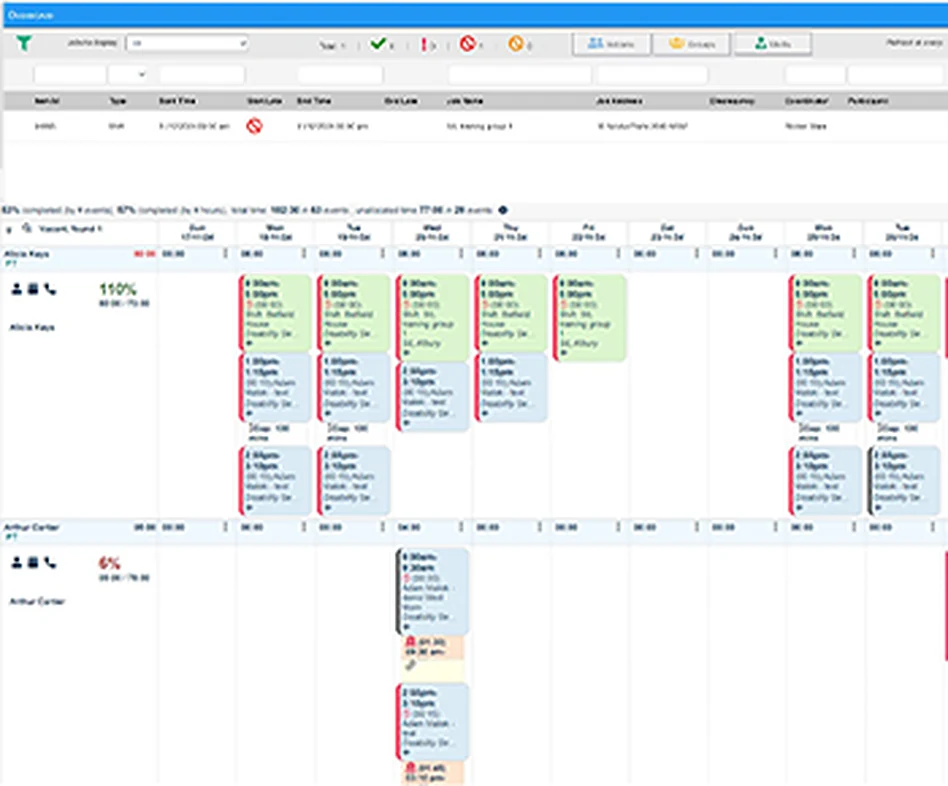
This is exactly the gap that a dedicated workforce and rostering system is built to close. Rather than relying on spreadsheets or a filing cabinet to track certificate expiry dates across dozens or hundreds of staff, a platform like VisiCase's care management software can hold each worker's qualifications, screening clearances, and training completions against their profile, flag anything approaching expiry, and prevent an unqualified or uncleared worker from being rostered onto a shift. This same governance discipline is what underpins clinical governance obligations more broadly.
How This Connects to Worker Screening and the Code of Conduct
Qualifications, screening, and conduct obligations overlap more than most providers expect. VisiCase has covered the screening side of this in detail in our guide to the Aged Care Worker Screening Check, which walks through the police certificate and NDIS Worker Screening Clearance pathways, who they apply to, and how to keep renewal dates under control.
The Code of Conduct for Aged Care sets the behavioural side of the same coin. It applies to every aged care worker, including volunteers, and sets expected standards around respect, honesty, and integrity, specifically to make sure people receiving care are treated with dignity and kept safe from harm. A worker can be fully qualified on paper and still breach the Code, which is why ongoing Code of Conduct training is built into the mandatory competency-based training list rather than treated as a once-off induction topic.
Providers already working through their obligations under the strengthened Aged Care Quality Standards, the broader Aged Care Act 2024, and the Serious Incident Response Scheme will recognise the pattern: documentation, verification, and an ongoing review cycle, not a single compliance event.
A Practical Checklist for Verifying Aged Care Worker Qualifications
Use this as a starting point for an internal audit, not a substitute for legal advice.
- List every role type delivering funded care, including contractors, agency staff, and volunteers, and note the minimum qualification or competency expected for each.
- Verify formal qualifications against the issuing training provider or AHPRA registration, rather than accepting a photocopied certificate at face value.
- Confirm worker screening status for every worker and responsible person: either a police certificate issued within three years, or a valid NDIS Worker Screening Check.
- Check training completion against your organisation's training matrix, covering person-centred care, dementia care, trauma-informed care, medical emergency response, and the Code of Conduct.
- Set expiry alerts for certificates, screening clearances, and mandatory refresher training, with enough lead time to act before something lapses mid-roster.
- Document your reasoning when you make a judgement call on a worker's suitability or competency, since the Commission expects to see not just the decision but the basis for it.
- Report workforce capability to the governing body on a regular cycle, not only when an audit is announced.
- Review subcontractor and agency arrangements to confirm the agency is applying the same verification standard you would apply to a direct hire.
Bringing Qualification Compliance Into Daily Operations
The organisations that handle this well stop treating qualification tracking as an annual exercise and build it into how rostering works day to day: one current record per worker, automatic alerts before anything expires, and a rostering process that will not schedule someone whose credentials have lapsed.
Case management platforms built for the sector, including VisiCase, exist to close the gap between "we have a policy" and "we can prove it happened" for every shift, every worker, every week. Providers who move this out of spreadsheets and into their core workforce system tend to find the next Commission visit far less stressful, because the evidence is already there.
Frequently Asked Questions
What qualifications do aged care workers need in Australia?
Most personal care roles require a nationally recognised qualification such as the Certificate III in Individual Support (Ageing), while nursing roles require current AHPRA registration.
Beyond formal certificates, the strengthened Quality Standards also require verified skills and experience, a current worker screening clearance, and completion of mandatory ongoing training in areas such as dementia care, trauma-informed care, and the Code of Conduct. The exact mix depends on the role: a personal care worker, a registered nurse, and an administrative staff member each sit under different qualification expectations, but all fall under the same Human Resource Management obligations.
Do all aged care workers need a Certificate III?
Not every role requires a Certificate III in Individual Support, but most direct personal care roles do, either as the qualification itself or as the recognised entry pathway into aged care work.
Roles like cooking, cleaning, gardening, and administration are still covered by the provider’s broader staff qualification obligations, but the relevant qualification there might be a food safety certificate or demonstrated experience rather than a Certificate III. Clinical roles such as registered and enrolled nurses need AHPRA registration instead.
Who is responsible for verifying aged care worker qualifications?
The approved provider, through its governing body, is responsible for verifying and recording worker qualifications, including for staff supplied through agencies or subcontractors.
This responsibility cannot be outsourced by using a labour hire or recruitment agency. The organisation that holds the aged care approval remains accountable for confirming that every worker delivering care on its behalf, whether employed directly or contracted in, meets the qualification, screening, and training requirements. The governing body, meaning the board or the owner of a smaller provider, is expected to directly oversee this rather than delegate it entirely to HR.
What is the difference between a qualification and a worker screening clearance?
A qualification demonstrates training and competence to do the job, while a worker screening clearance confirms the person is suitable to work with older people based on a police certificate or NDIS Worker Screening Check.
Both are mandatory and both need to be current, but they answer different questions. A fully qualified worker without a valid clearance, or a cleared worker without the right training, is equally non-compliant. Providers need to track both, for every worker, rather than treating either one as sufficient on its own.
How often should staff qualifications and screening clearances be reviewed?
Police certificates are generally valid for three years and NDIS Worker Screening Checks for five years, so providers need a review cycle that catches renewals before they lapse rather than after.
Mandatory competency-based training, covering areas like dementia care and the Code of Conduct, is expected to be completed regularly rather than once at induction, so most providers build an annual or role-based refresher cycle into their training matrix. The practical answer is to set expiry alerts the moment a credential is verified, rather than relying on staff to remember their own renewal dates.
Does the Aged Care Act 2024 introduce new qualification requirements?
The Aged Care Act 2024 and the accompanying Aged Care Rules 2025 strengthen existing obligations around worker qualifications, suitability, and screening rather than replacing them outright.
The core requirement, that providers verify and record staff qualifications, skills, and experience, already existed under the Aged Care Act 1997. What has changed is the detail and enforcement: the strengthened Quality Standards spell out exactly what “skilled and competent” needs to look like in practice, and the worker screening regime has been formalised and extended to cover a much wider group of workers, contractors, and volunteers from 1 November 2025.
Do volunteers need the same qualifications as paid aged care workers?
Volunteers can be captured by the definition of “aged care worker” and may need to meet screening and Code of Conduct obligations, even though they are not typically expected to hold the same formal qualifications as paid staff.
Whether a volunteer role triggers screening depends on how much contact they have with people receiving care. A volunteer helping with office admin is treated differently to one providing hands-on support, so providers should assess each volunteer role individually rather than assume volunteers sit outside the framework entirely.
What records must providers keep for aged care worker qualifications?
Providers must keep accurate, accessible records covering pre-employment checks, contact details, qualifications, experience, training completions, and screening clearance details, including screening IDs and expiry dates.
Records can be electronic or written, but they need to be available on request, and providers should also document the reasoning behind any judgement calls made about a worker’s competency or suitability. This record-keeping obligation extends to contractors and agency-supplied staff, not just direct employees.
Can a worker start before their qualification or screening check is finalised?
In limited circumstances, a worker can start under a statutory declaration while a screening check is pending, provided appropriate supervision is in place, but this cannot be used to cover an expired certificate for an existing worker.
This is an exception for new workers awaiting the outcome of a screening application, not a general workaround for qualification gaps. Providers relying on this pathway still need to apply appropriate supervision and should not treat it as a substitute for verifying formal qualifications or training completion.
How can software help manage staff qualifications in aged care?
Workforce and case management software can hold each worker’s qualifications, screening clearances, and training completions in one record, send alerts before anything expires, and stop an unqualified or uncleared worker from being rostered onto a shift.
For providers managing qualification and clearance data across dozens or hundreds of staff in spreadsheets, this is usually where compliance gaps start: a renewal missed, a certificate not followed up, a roster built without checking who is actually current. Centralising that data inside a platform like VisiCase turns an annual scramble into an ongoing, checkable process.