Disability Support Worker Pay Rates: Your Ultimate 2026-27 Guide to the SCHADS Award
Understand disability support worker pay rates under the SCHADS Award 2026-27, including classification levels, penalty rates and allowances.



If you run an NDIS or disability services business, keeping up with disability support worker pay rates is a non-negotiable compliance task. Get the rates wrong and you face underpayment claims, Fair Work investigations, and penalties that can reach well into the hundreds of thousands of dollars for repeat or serious breaches.
Disability support worker pay rates in Australia are set by the Social, Community, Home Care and Disability Services Award 2010, known as the SCHADS Award (MA000100). From the first full pay period on or after 1 July 2026, minimum base rates range from $27.55 per hour for a Level 1 entry-level worker to $46.70 per hour for a Level 4 team leader or case coordinator. Casual workers receive a 25 per cent loading on top of these base rates. Weekend, evening, and public holiday shifts attract additional penalty rate multipliers of between 112.5 per cent and 250 per cent.
This guide covers the current SCHADS Award disability support worker pay rates, the classification levels that determine what each worker should be paid, penalty rates, key allowances, and what this means for your NDIS rostering and budget decisions.
Table of Contents
- What Is the SCHADS Award?
- How Disability Support Worker Classifications Work
- Disability Support Worker Pay Rates: 2026-27 Schedule B Rates
- Casual vs Part-Time vs Full-Time Pay
- Weekend, Evening and Public Holiday Penalty Rates
- Key SCHADS Award Allowances
- How Pay Rates Affect Your NDIS Budget Planning
- Why Correct Classification Matters for Compliance
- How Rostering Software Helps Manage SCHADS Pay Compliance
- Frequently Asked Questions
What Is the SCHADS Award?
The Social, Community, Home Care and Disability Services Award 2010 (MA000100) is the national modern award that sets minimum pay and working conditions for disability support workers across Australia. The Fair Work Commission administers the award and reviews minimum rates annually.
The SCHADS Award covers disability support workers, home care workers, social and community services workers, and crisis accommodation workers. If you employ disability support workers in your NDIS business, the SCHADS Award applies to those employees unless a registered enterprise agreement is in place that provides at least equal overall conditions.
The award sets minimum rates only. You can pay above the award, but you cannot pay below it. Any shortfall, even an accidental one, is an underpayment under the Fair Work Act 2009.
How Disability Support Worker Classifications Work
Before applying disability support worker pay rates, you need to classify each worker correctly under the award. The classification determines the minimum pay rate that applies.
Under Schedule B of the SCHADS Award, disability support workers fall into one of eight levels, each with multiple pay points. The level depends on the worker's qualifications, experience, and the complexity of the tasks they perform.
Level 1 covers entry-level workers with minimal formal qualifications, including workers still completing their Certificate III or who have no prior experience in disability services.
Level 2 applies to workers who hold a Certificate III or Certificate IV in Disability Support, or who have demonstrated equivalent competency through experience. This is the most common level for frontline disability support workers.
Level 3 applies to senior support workers or house supervisors who provide leadership, mentoring, or supervision to Level 1 and Level 2 workers.
Level 4 covers team leaders, case coordinators, and workers with significant supervisory or coordination responsibilities.
Levels 5 through 8 apply to program coordinators, service managers, regional managers, and general managers. These higher levels are less directly relevant to frontline disability support worker pay rates but matter for workforce budget planning.
Workers are also promoted through pay points within each level as they gain experience, so a Level 2 worker does not stay at PP1 rates indefinitely. Failure to advance workers through pay points is a common compliance gap.
Disability Support Worker Pay Rates: 2026-27 Schedule B Rates
The following base rates apply from the first full pay period on or after 1 July 2026 under Schedule B of the SCHADS Award. Casual rates include the 25 per cent loading.
| Classification | Description | Hourly Rate | Casual Hourly Rate |
|---|---|---|---|
| Level 1 PP1 | Entry level, no qualifications | $27.55 | $34.44 |
| Level 1 PP2 | $28.44 | $35.55 | |
| Level 1 PP3 | $29.45 | $36.81 | |
| Level 2 PP1 | Cert III/IV disability support | $36.22 | $45.28 |
| Level 2 PP2 | $37.36 | $46.70 | |
| Level 2 PP3 | $38.50 | $48.13 | |
| Level 2 PP4 | $39.53 | $49.41 | |
| Level 3 PP1 | Senior support worker | $40.49 | $50.61 |
| Level 3 PP2 | $41.66 | $52.08 | |
| Level 3 PP3 | $42.55 | $53.19 | |
| Level 3 PP4 | $43.42 | $54.28 | |
| Level 4 PP1 | Team leader/case coordinator | $46.70 | $58.38 |
| Level 4 PP2 | $47.92 | $59.90 | |
| Level 4 PP3 | $49.16 | $61.45 | |
| Level 4 PP4 | $50.25 | $62.81 |
Source: SCHADS Award (MA000100), Schedule B, effective 1 July 2026 (PR813674 amendments to 1 September 2026 included). These are minimum rates. Providers operating in competitive labour markets often pay above award to attract and retain experienced workers.
Casual vs Part-Time vs Full-Time Pay
Employment type significantly affects how disability support worker pay rates work in practice.
Full-time workers are employed for 38 ordinary hours per week. They receive the base hourly rate plus any applicable penalty rates and shift loadings. Leave entitlements accrue at the standard rate.
Part-time workers are employed for regular hours below 38 per week. They receive the same base rate and penalty rates as full-time workers, plus leave entitlements calculated on a pro-rata basis.
Casual workers receive the base rate plus a 25 per cent casual loading in lieu of leave entitlements and notice. This loading applies on top of penalty rates, so a casual worker on a Sunday receives both the casual loading and the Sunday penalty multiplier.
Under the SCHADS Award, casual workers also have rights to convert to permanent employment after 12 months of regular work. This is an area of active compliance attention in the NDIS sector and one that affects workforce planning decisions for many providers. For more on what this means operationally, see VisiCase's guide to casual conversion entitlements under the SCHADS Award.
Weekend, Evening and Public Holiday Penalty Rates
Penalty rates are one of the most common sources of payroll errors for NDIS providers. The SCHADS Award applies different multipliers depending on the day, the time, and the worker's employment type.
Using a Level 2 PP1 worker at $36.22 per hour as the example:
| Shift type | Multiplier | Approximate rate (Level 2 PP1) |
|---|---|---|
| Monday to Friday (ordinary hours) | 100% | $36.22 |
| Afternoon shift (finishing after 8:00 pm but before midnight, Mon-Fri) | +12.5% loading | $40.75 |
| Night shift (finishing after midnight or starting before 6:00 am, Mon-Fri) | +15% loading | $41.65 |
| Saturday | 150% | $54.33 |
| Sunday | 200% | $72.44 |
| Public holiday | 250% | $90.55 |
Overtime rates also apply under the SCHADS Award:
- First two hours of overtime (Monday to Saturday): 150%
- After two hours of overtime (Monday to Saturday): 200%
- Overtime on Sunday: 200%
- Overtime on a public holiday: 250%
For casual workers, overtime multipliers are higher. The first two hours of overtime Monday to Saturday attract 187.5 per cent, increasing to 250 per cent after that. Sunday overtime for casuals is 250 per cent, and public holiday overtime is 312.5 per cent.
Overtime begins once a full-time or part-time worker exceeds 38 hours per week, 76 hours per fortnight, or 10 hours in a single day.
These rates make shift scheduling decisions financially significant for NDIS providers. A single unplanned evening shift that runs past 8:00 pm adds a 12.5 per cent loading. A Sunday callout on a casual contract can triple the base rate.
Key SCHADS Award Allowances for Disability Support Workers
Beyond base and penalty rates, disability support worker pay rates include several allowances that must be tracked and paid correctly every pay period.
Sleepover allowance: $62.87 per overnight period. This applies when a worker is required to sleep at a client's home and remain available if needed. If the worker is woken to provide active care, that time must be paid at overtime rates, with a minimum payment of one hour.
Broken shift allowance: $21.81 per shift when a worker works a shift with one unpaid break that is not a standard meal break. This rises to $28.87 when the shift includes two such unpaid breaks. These allowances compensate workers for interrupted rosters where unpaid time falls between shift blocks.
Vehicle allowance: $1.01 per kilometre from July 2026, increasing to $1.05 per kilometre from 1 September 2026 through 28 February 2027, then returning to $1.01 from 1 March 2027. This applies when workers use their own vehicles for work-related travel between clients or locations.
Meal allowance: $17.30 per meal when a worker is required to work overtime for more than two hours without prior notice and cannot access their usual meal.
On-call allowance: $25.66 per 24-hour period for Monday to Friday on-call. This rises to $50.81 per 24-hour period on weekends and public holidays.
First aid allowance: $21.43 per week for workers who hold a first aid certificate and are required to apply that training in their role.
Uniform allowance: $1.26 per shift when the employer requires a uniform but does not supply one. If the employer requires laundering of non-work-issued clothing, an additional $0.33 per shift applies.
Each allowance must be tracked and paid accurately across every pay period. Missing a sleepover allowance across ten workers in a fortnight is a material underpayment. Manual rostering spreadsheets create ongoing risk here.
How Pay Rates Affect Your NDIS Budget Planning
Disability support worker pay rates under the SCHADS Award directly affect your ability to deliver services within the limits set by the NDIS Price Guide. Understanding this connection is essential for financially sustainable service delivery.
The NDIS Price Guide 2026-27 sets maximum support rates for each type of support. Providers must ensure their wage costs, combined with overhead and administration costs, fit within these limits while still meeting award obligations.
Your rostering decisions have direct cost consequences:
- Scheduling an afternoon shift that runs past 8:00 pm adds a 12.5 per cent shift loading on top of the base rate.
- Rostering a Level 3 worker for tasks that a Level 2 worker can deliver safely and competently means paying a higher rate for the same outcome.
- Miscalculating overtime means either underpaying staff or overrunning service delivery budgets.
- Running sleepovers without tracking woken hours means missing overtime payments and creating audit exposure.
Building pay rate knowledge into your rostering decisions before shifts start, rather than discovering the cost in the payroll run afterward, is the more financially sustainable approach for NDIS providers.
Why Correct Classification Matters for Compliance
Misclassifying a disability support worker at a lower level than their qualifications and duties require creates an underpayment risk under the Fair Work Act. The Fair Work Ombudsman actively investigates underpayments in the disability sector, and back-pay orders can reach up to six years.
Common classification errors include:
- Keeping an experienced worker on Level 1 rates after they complete a Certificate III in Disability Support
- Failing to advance workers through pay points as they gain experience
- Applying Schedule E (home care) rates to workers who should be classified under Schedule B
- Not reviewing classifications when workers take on supervisory or coordination duties
Maintaining up-to-date classification records for every worker, including their qualifications and effective start dates, is essential for audit readiness. For a full breakdown of what qualifications affect NDIS support worker classification, see VisiCase's guide to NDIS support worker qualification requirements.
How Rostering Software Helps Manage SCHADS Pay Compliance
Manually tracking disability support worker pay rates across multiple classification levels, employment types, and shift patterns is a significant operational burden. Payroll errors are common and expensive, often going undetected until a Fair Work audit or staff complaint.
Purpose-built NDIS workforce management software automates the process by:
- Applying the correct classification and pay rate to each worker's shifts automatically
- Calculating penalty rates and allowances in real time as rosters are built
- Flagging potential overtime breaches before rosters are confirmed
- Generating accurate payroll data for each pay period
- Maintaining classification and qualification records against each worker's profile
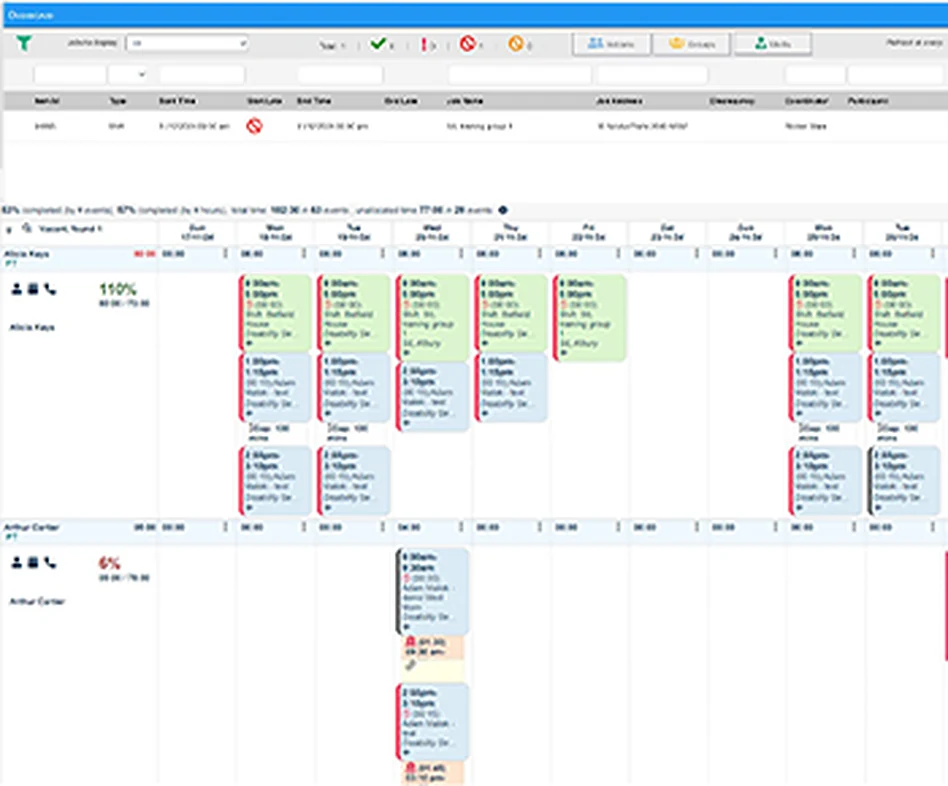
VisiCase is built specifically for NDIS, disability, and aged care providers. The platform manages rostering, workforce compliance, case management, and SCHADS Award pay rules in one place. When you build a roster in VisiCase, it applies the correct disability support worker pay rates based on each worker's classification, employment type, and the shifts assigned, before the roster is locked in.
Explore VisiCase's NDIS workforce management features or learn more about NDIS provider software solutions to see how the platform handles SCHADS Award compliance at scale.
Conclusion
Disability support worker pay rates under the SCHADS Award change each year with the Fair Work Commission's annual wage review, and the allowance and penalty rate structures require consistent, accurate application across every roster and pay cycle. Providers who rely on manual processes face growing compliance exposure as the complexity of SCHADS Award obligations continues to increase.
Building pay rate knowledge into your rostering systems, not just your payroll, is the smarter path to sustainable NDIS service delivery. When your rostering tool applies the correct rates in real time, pay compliance becomes a natural output of good rostering, not a separate check that happens too late.
Ready to see how VisiCase applies the correct disability support worker pay rates across your roster before each shift starts? Book a VisiCase demo today.
Frequently Asked Questions
What is the minimum pay rate for a disability support worker in Australia in 2026-27?
The minimum rate under the SCHADS Award from 1 July 2026 is $27.55 per hour for a Level 1 Pay Point 1 worker. The casual rate at this level is $34.44 per hour.
The base rate depends on the worker’s classification under Schedule B of the SCHADS Award. Level 1 applies to entry-level workers without formal qualifications. Workers who hold a Certificate III or Certificate IV in Disability Support typically classify at Level 2, where the minimum base rate starts at $36.22 per hour ($45.28 casual). These are minimum rates; employers can pay above the award, but cannot pay below it. Failure to meet the minimum constitutes an underpayment under the Fair Work Act 2009.
What is the difference between Schedule B and Schedule E under the SCHADS Award?
Schedule B covers social and community services workers, including most frontline disability support workers. Schedule E covers home care workers. The same worker may fall under a different schedule depending on the type of service they deliver.
Workers employed to provide disability support in community or residential settings typically fall under Schedule B. Workers employed under a home care model, delivering personal care in a participant’s own home, may fall under Schedule E. A Schedule E Level 2 PP1 worker earns $28.86 per hour, compared to $36.22 for a Schedule B Level 2 PP1 worker. If you are unsure which schedule applies to your workers, check the award classifications carefully or seek guidance from the Fair Work Ombudsman or a qualified employment law specialist.
What do NDIS providers have to pay casual disability support workers on Sundays?
Casual disability support workers are paid at 225 per cent of their ordinary rate on Sundays. This combines the 200 per cent Sunday penalty multiplier with the 25 per cent casual loading.
For a casual Level 2 PP1 worker with an ordinary base rate of $36.22, the Sunday casual rate calculates to approximately $81.50 per hour. NDIS providers must factor these rates into their budgets when scheduling casual workers on weekends, as they represent a significantly higher cost compared with weekday ordinary hours. Accurate rostering software that calculates penalty rates in real time before the roster is confirmed helps providers avoid budget overruns on weekend shifts.
When does overtime apply for disability support workers under the SCHADS Award?
Overtime applies when a worker exceeds 38 hours per week, 76 hours per fortnight, or 10 hours in a single day.
The first two hours of overtime from Monday to Saturday attract a rate of 150 per cent. After two hours, overtime is paid at 200 per cent. Overtime on Sundays is 200 per cent and on public holidays is 250 per cent. For casual workers, these multipliers are higher: 187.5 per cent for the first two overtime hours Monday to Saturday, 250 per cent thereafter, and 250 per cent flat on Sundays and public holidays. NDIS providers need to monitor accumulated hours carefully across pay periods, particularly for part-time workers who regularly take on extra shifts. Untracked overtime creates both a payroll liability and a compliance risk.
What is the sleepover allowance for disability support workers?
The SCHADS Award sleepover allowance is $62.87 per night from 1 July 2026.
This allowance applies when a worker is required to sleep at a participant’s premises overnight and be available to assist if needed. If the worker is woken during the sleep period to provide active care, that active time must be paid at overtime rates, with a minimum payment of one hour. Providers who roster sleepovers must pay both the allowance and any active hours worked during the night. Failure to pay the sleepover allowance, or failure to record and pay woken hours, is a common audit finding in the disability sector and a frequent source of back-pay orders from the Fair Work Ombudsman.
Do disability support workers get a pay rise in 2026?
Yes. The Fair Work Commission’s annual wage review applied from the first full pay period on or after 1 July 2026, increasing minimum rates across all SCHADS Award classifications.
The annual minimum wage decision increases SCHADS Award rates each July. NDIS providers must update their payroll systems and rostering tools to reflect the new rates from the effective date. Failure to apply the updated rates from the first qualifying pay period is an underpayment, even if unintentional. Providers should also review whether updated NDIS Price Guide limits reflect the wage increase, as the gap between maximum billable rates and award wage obligations affects service delivery viability.
What is the broken shift allowance under the SCHADS Award?
The broken shift allowance is $21.81 when a shift includes one unpaid non-meal break, rising to $28.87 when it includes two such breaks.
Broken shifts occur when a provider schedules a worker across two separate blocks of time in a day with an unpaid gap between them that is not a standard meal break. The allowance compensates workers for the inconvenience of spending uncompensated time away from home between shift blocks. Broken shift rosters are common in disability and aged care services, where participant needs may require a morning shift and a separate evening shift on the same day. Each broken shift in a pay period must be tracked and the allowance paid accurately to avoid underpayment.
Are NDIS support workers covered by the SCHADS Award?
Yes. Most NDIS support workers employed under a standard employment arrangement are covered by the SCHADS Award unless a registered enterprise agreement is in place.
The SCHADS Award (MA000100) covers employees of organisations providing disability support services, including NDIS-registered providers. Self-employed support workers operating as independent contractors or sole traders are not covered by the award. If your organisation has a registered enterprise agreement, the agreement must provide conditions at least as favourable as the award overall. The Fair Work Ombudsman provides guidance on award coverage for the disability sector and can assist providers who are unsure whether their workforce is covered.
How does worker classification affect NDIS rostering decisions?
Higher classifications carry higher minimum pay rates, so assigning the right classification to the right task helps providers control labour costs while meeting their award obligations.
Rostering a Level 3 worker for tasks that a Level 2 worker can safely and competently deliver means paying a higher rate for the same outcome. This directly affects how many hours a service budget can fund. At the same time, assigning a worker to duties that require a higher classification without updating their pay level creates an underpayment risk. Getting classification right, documenting qualifications, and reviewing classifications when workers gain new credentials keeps both costs and compliance on track. Tools that link worker profiles to their award level and reflect that in real-time cost calculations make this process significantly more manageable for multi-site NDIS providers.
What happens if an NDIS provider underpays a disability support worker?
Underpayment under the SCHADS Award is a serious compliance breach. The Fair Work Ombudsman can require back payment with interest, issue infringement notices, and impose penalties under the Fair Work Act.
Back-pay orders can cover up to six years of underpayment. Penalties for serious contraventions of the Fair Work Act can reach significant amounts for organisations, particularly for repeat or deliberate breaches. Beyond financial penalties, underpayment damages the provider’s reputation and its ability to attract and retain disability support workers in a sector already facing workforce pressures. Providers who discover underpayments should address them promptly and document the correction process. NDIS providers with a history of non-compliance may also face scrutiny during NDIS Commission audits, as workforce management and labour compliance fall within the scope of the NDIS Practice Standards.