NDIS Core Supports: What Every Provider Needs to Know
Understand NDIS core supports - what the 4 categories cover, how claiming works, and practical guidance for providers delivering these supports in Australia.



NDIS core supports are the foundation of most NDIS plans. For the majority of participants, the core supports budget is the largest and most actively used part of their funding, and for providers, understanding how these supports work is not optional - it is essential to delivering quality services, claiming correctly, and staying compliant.
NDIS core supports are four budget categories that fund the everyday assistance participants need to live their lives. The four categories are Assistance with Daily Life, Consumables, Assistance with Social and Community Participation, and Transport. In most cases, participants can move funding between these categories, giving providers and participants genuine flexibility in how support is delivered and funded.
This guide breaks down each category, explains how claiming works, outlines the price limits providers must follow, and covers the common mistakes that lead to claim rejections - so your team can deliver NDIS core supports with confidence.
What Are NDIS Core Supports?
NDIS core supports fund the day-to-day assistance a participant needs because of their disability. They are one of three main budget types in an NDIS plan, alongside Capacity Building supports (which fund skill development and independence) and Capital Supports (which fund equipment, assistive technology and home modifications).
The core supports budget exists because many people with disability need ongoing, practical help - not just one-off training or a piece of equipment. Personal care, help getting out into the community, and reliable transport are recurring needs that NDIS core supports are designed to fund.
What makes NDIS core supports particularly useful is the flexibility rule. In most standard NDIS plans, participants can redirect unspent funding from one core support category to cover another. If a participant has leftover Consumables funding halfway through their plan, they can put that money toward extra Assistance with Daily Life hours instead. This flexibility is a deliberate feature of NDIS core supports, designed to help participants respond to changing needs without waiting for a plan review.
That said, flexibility is not universal. Some participants have stated supports in their plan - funding locked to a specific support item or provider. Understanding when flexibility applies and when it does not is one of the most important things any NDIS provider needs to know.
The 4 Categories of NDIS Core Supports
1. Assistance with Daily Life
Assistance with Daily Life (support category 01 in the NDIS Support Catalogue) covers help with personal and domestic tasks a participant cannot do independently because of their disability. This is usually the largest category within NDIS core supports, and for many residential and home-based providers, it is their primary service area.
Common supports in this category include:
- Personal care: showering, dressing, grooming and hygiene
- Meal preparation and assistance with eating
- Domestic assistance: cleaning, laundry and household tasks
- Overnight and 24-hour care
- Supported Independent Living (SIL) in shared accommodation
- Respite and short-term accommodation (STA)
- Group activities in day programs or centre-based settings
The rate a provider can charge depends on the time of day, the day of the week, and the support setting. Standard weekday rates (Monday to Friday, between 6am and 8pm) are lower than evening, Saturday, Sunday or public holiday rates. Providers must apply the correct rate for every shift when submitting claims.
2. Consumables
Consumables (category 02) covers everyday products a participant uses because of their disability. These are low-cost, recurring items that do not require a formal assessment to access and are typically purchased directly by participants or their representatives.
Examples include:
- Continence products: pads, catheters and related supplies
- Low-cost assistive technology items (reaching tools, non-slip matting, activity boards)
- Nutritional supplements prescribed for a disability-related need
- Basic wound care supplies
Consumables are most commonly managed by participants themselves or through a plan manager. The participant or plan manager pays for the item and either claims reimbursement or submits the invoice directly. For providers supplying consumable items, documentation is essential - each item must be clearly disability-related, and the cost must fall within the NDIS price limit for that support item.
3. Assistance with Social and Community Participation
This category (09) funds the support a participant needs to take part in community life - not the activity itself, but the worker who assists them while they are there. The NDIS funds access and inclusion, not recreation.
Supports commonly funded here include:
- Community access outings and social activities
- Support to attend community groups or events
- Support at sporting, cultural or faith-based activities
- Group programs in community settings
Like Assistance with Daily Life, pricing in this category varies by time of day and day of week. A support worker helping a participant attend a Sunday afternoon event is claimed at the Sunday rate, not the standard weekday rate. Applying the wrong rate is one of the most frequent billing errors in this category.
4. Transport
Transport (category 11) funds either direct travel costs for the participant or the cost of a support worker’s time helping them travel. This category works differently from the other three.
In many NDIS plans, transport funding is pre-loaded as a fixed amount per week or fortnight, which the participant uses for taxis, ride-share or other transport costs. Providers delivering a support that involves travelling with the participant - for example, accompanying them to a medical appointment - may also claim an additional transport loading on top of their service claim, within the limits set by the NDIS Pricing Arrangements.
Transport supports are often underutilised in participants’ plans, so it is worth making sure your team understands how to record and claim transport-related costs correctly.
Flexibility Rules for NDIS Core Supports
The ability to move funding between NDIS core support categories is one of the most practically useful aspects of the NDIS funding structure. Here is how it works in practice.
For most standard NDIS plans, the core supports budget is flexible across all four categories. A participant with a large Daily Life allocation and a small Consumables allocation can effectively use all of that funding on Daily Life supports if that is where their need sits. They do not need to call the NDIA or request a plan change to do this - the flexibility is built into the plan from the start.
However, stated supports change this picture entirely. A stated support is a specific support item or provider listed in the participant’s plan with a fixed funding amount. That money cannot be redirected elsewhere. If a participant has a stated transport support of $150 per fortnight, that $150 stays as transport - it cannot be used for personal care or community access.
Providers should always check the participant’s plan carefully before assuming flexibility is available. If the participant is plan-managed, their plan manager will have this information. If you are unsure, ask the participant directly or request a copy of the relevant plan section.
Getting this wrong in either direction creates problems: overclaiming on a stated support can be treated as a compliance issue, while underclaiming because of a mistaken belief that funds are locked away wastes resources the participant is entitled to use.
NDIS Core Supports Price Limits and the Pricing Arrangements
Every NDIS core support has a maximum price. These limits are set in the NDIS Pricing Arrangements and Price Limits document, which is published by the NDIA and updated at least once per year (sometimes more frequently if the NDIA makes mid-year adjustments).
For Assistance with Daily Life and Social and Community Participation, price limits vary based on:
- Time of day (standard hours, evening hours, overnight)
- Day of the week (weekday, Saturday, Sunday)
- Public holidays
- Support setting (standard home/community vs. SIL)
- Ratio of workers to participants (1:1, 1:2, 1:3, group)
Providers cannot charge above these limits, even if the participant or their representative agrees in writing to pay more. Any arrangement that exceeds the NDIS price limit is not enforceable, and charging above the limit could put the provider’s NDIS registration at risk.
Staying current with pricing changes is a provider responsibility. When a new Pricing Arrangements document is released, providers need to update their billing systems and service agreements to reflect the new rates. Using outdated rates - even accidentally - can result in overclaiming, which the NDIA may audit and require repayment for.
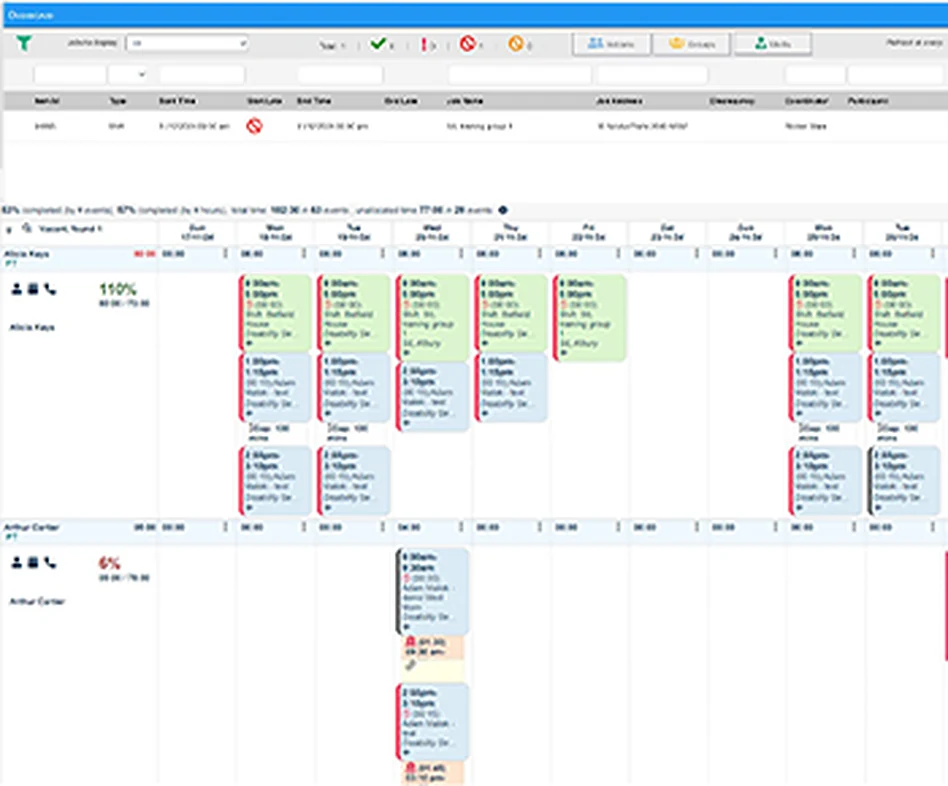
For providers managing large workforces across multiple participants and shift types, manually tracking and applying the correct rate is a significant operational burden. Purpose-built NDIS management software that automatically applies the current pricing rules to each shift type can eliminate this risk while saving hours of administrative work each week. See how VisiCase handles NDIS rostering and billing for your team.
How Claiming Works for NDIS Core Supports
The claiming process for NDIS core supports depends on how the participant’s plan is managed. There are three management types, and each works differently.
NDIA-managed (Agency-managed): The NDIA holds and pays out the participant’s funding directly. Registered providers must submit claims through the NDIS myplace provider portal after each service is delivered, referencing the correct support item number from the NDIS Support Catalogue. Claims for NDIS core supports are typically processed within two to three business days.
Plan-managed: A registered plan manager holds and administers the participant’s budget. The provider submits invoices to the plan manager, who pays from the participant’s NDIS funds. Plan managers have their own processing timelines, usually within five business days. Providers do not need to be registered with the NDIS to work with plan-managed participants.
Self-managed: The participant manages their own NDIS funds directly. Providers invoice the participant, who then claims reimbursement from the NDIA. Self-managed participants can use unregistered providers. Rates are still subject to the NDIS price limits.
For agency-managed plans, every NDIS core supports claim must include the correct support item number. Using the wrong item number - even if the support type is correct - will cause the claim to be rejected. Providers should verify support item numbers against the current NDIS Support Catalogue for each service type they deliver.
Common Provider Mistakes When Delivering NDIS Core Supports
Even experienced providers can run into problems with NDIS core supports claims. These are the most frequent errors and how to avoid them.
- Applying the wrong rate: Standard weekday rates do not apply on Saturdays, Sundays, public holidays, or for shifts that extend into evening or overnight hours. Every shift must be matched to the correct rate before a claim is submitted.
- Using the wrong support item number: Different support settings and participant ratios attract different item codes. A group activity support item is not the same as a 1:1 support item, even if the same worker is involved.
- No service agreement: Providers must have a current, signed service agreement with every participant before delivering NDIS core supports. Delivering services without an agreement in place is a compliance risk.
- Late claiming: Claims submitted long after the service date can cause problems if the participant’s plan has ended or been reviewed. Build a regular claiming schedule into your operations.
- Not verifying stated supports: Claiming flexibly on a stated support item is a compliance issue. Confirm with the participant or plan manager which parts of the core supports budget can be used flexibly before each service cycle.
- Outdated pricing: Using last year’s rate schedule rather than the current NDIS Pricing Arrangements. Set a reminder to check for NDIS pricing updates at least annually.
Managing NDIS Core Supports at Scale
For providers with a small caseload, managing NDIS core supports manually is feasible. As your organisation grows, the same processes that worked for 20 participants do not scale to 100 or 200.
At scale, the operational challenges multiply: matching the right worker to each participant, rostering across different support types and time slots, tracking which shifts attract which rate, maintaining service agreements for every participant, and submitting accurate claims on time - all while keeping detailed records for potential audits.
Providers working at this level need systems that handle these tasks reliably, automatically and with a clear audit trail. VisiCase is built specifically for NDIS and aged-care providers. The platform manages rostering, shift tracking, billing and compliance documentation in one place, so your team spends less time on administration and more time on the work that matters.
If your organisation is growing or you are spending too much time on billing errors and rework, book a demo to see how VisiCase can support your NDIS core supports delivery.
Conclusion
NDIS core supports are the backbone of most NDIS plans, covering the everyday assistance participants need to live independently and participate in their communities. The four categories - Assistance with Daily Life, Consumables, Social and Community Participation, and Transport - each have their own rules, support items and price limits, and understanding these details is essential for every registered NDIS provider.
Getting NDIS core supports delivery right means knowing the flexibility rules, applying the correct rate for every shift, using the right support item numbers, and maintaining service agreements and records that will hold up to scrutiny. These are achievable standards with the right processes and systems in place.
For more information on how VisiCase supports NDIS providers, visit our NDIS solutions page or explore our full features overview.
Frequently Asked Questions About NDIS Core Supports
What are NDIS core supports?
NDIS core supports are one of the three NDIS budget types. They fund the everyday assistance a participant needs because of their disability, alongside Capacity Building and Capital Supports.
What are the four categories of NDIS core supports?
The four categories are Assistance with Daily Life, Consumables, Assistance with Social and Community Participation, and Transport. Each has its own support items and rules.
Can participants move funding between core support categories?
In most standard NDIS plans, yes. Participants can usually redirect unspent funding from one core support category to another, which gives providers and participants flexibility. Some plans restrict this, so always check the participant's plan before delivering supports.
How do providers claim for NDIS core supports?
Providers claim for supports that have actually been delivered, using the correct support item number and a rate at or below the price limit. The process depends on how the plan is managed: NDIA-managed claims go through the NDIS portal, plan-managed participants are invoiced via their plan manager, and self-managed participants are invoiced directly.
What are the price limits for NDIS core supports?
Price limits are set in the NDIS Pricing Arrangements and Price Limits, which are reviewed and updated regularly. Providers must not charge more than the limit for the relevant support item, so it is important to apply the correct rate for each shift.
Why do NDIS core supports claims get rejected?
Common causes include using the wrong support item number or rate, claiming against a category with insufficient funds, claiming outside the plan dates, and missing service agreements or shift records. Accurate records and the right systems help prevent these errors.