Working in the NDIS: how do we overcome frontline challenges?
Working in the NDIS comes with unique frontline challenges. Discover proven insights on wages, shifts, and career growth today.


4 minute read – NDIS Carers Series – Working in the NDIS
When researching the state of play in the NDIS, most of what you will find online is about service providers and how these organisations have performed over recent years.
You will see the challenges many have faced financially and operationally, and overwhelmingly, the difficulty they continue to have attracting, recruiting and retaining the right people to their businesses.
But who are these ‘right’ people? And, as the carers who deliver NDIS services, on the frontline, everyday – how are you fairing?
In this brief report, we look past the organisations, to those people who facilitate the delivery of NDIS services, and consider how the industry has changed and will change, over time.
The NDIS experience
As service providers worked to meet demanding new requirements to facilitate the rollout, frontline staff facing the reality of working in the NDIS have encountered their own distinct set of difficulties.
According to a 2020 UNSW survey of more than 2,000 NDIS workers, only one in five feel the NDIS has been a positive experience for them.
They reported many core tasks that enable quality service delivery are performed outside hours and are unpaid. On average more than 2 hours daily are spent completing case notes and reports and communicating with colleagues or supervisors after clocking out.
While many frontline workers have shared with us inspiring and motivational stories about their experience, often these have been mixed with difficulties they need to overcome with salary, shifts and hours, management, and processes.
Employment stability
One of the most often repeated concerns for frontline staff working in the NDIS has been and continues to be employment stability.
The NDS State of the Disability Sector points to a decrease in casual workers and, at 62% of their sample, the highest level of permanent employment since 2015.
Despite this, UNSW’s survey of workers names casualization of the workforce as an ongoing concern, noting many staff have to work part-time across multiple jobs while managing unpredictable rostering and changing shift patterns.
This unpredictability can lead to a lack of continuity in service provision, something that frontline employees, as well as their employers, are very much aware of.
Worrying about wages while working in the NDIS
Not surprisingly, like most middle- and lower-income Australians, those working in the NDIS are worried about their take-home pay.
Joboutlook.gov.au reports aged and disability workers in Australia are paid under the average Australian weekly income.
UNSW found that workers were spending their own funds on expenses such as travel, and 20% expect to not have enough superannuation when they retire.
Job requirements
Running right alongside the difficulty for service providers to attract, recruit, and retain is skills and staff shortages that can change the requirements of frontline and mid-level managers.
According to UNSW, almost half of respondents were concerned they did not get enough time with their supervisors to discuss clients and their essential needs.
In turn, their supervisors provided some clarity on why this might be the case: they have too many people to oversee, which results in Cert IV employees making important decisions without the guidance they need.
Future prospects
When evaluating long-term prospects, one major concern for frontline employees working in the NDIS is determining their next career step—how to move up, upskill, and build a lasting career.
A clear lack of training remains a central issue, alongside the reality that much of the offered development occurs outside work hours, eating into limited personal time.
Consequently, research suggests many staff will leave the industry within five years, even as participant numbers grow toward 500,000 or more. Retaining top talent remains a critical battle for providers.
What can be done?
When it comes down to it, we have to fight the battles where we know we can have some wins.
The NDIS is still evolving and continuing to iron out some of those wrinkles that are challenging service providers.
Likewise, service providers are continuing to work on their employer brand, their culture, their response to NDIS requirements.
Experts in business, specialists in care recruitment and career planning, as well as training providers tell us the best thing a frontline worker can do to improve where they work, how they work and the industry as a whole, is to communicate.
By providing constructive feedback about salary, working conditions, training and future prospects, you can ensure your organisation knows what you need – and isn’t left to guess.
You can make certain a dialogue is opened up, so your senior leaders can openly and transparently communicate with you about the challenges they are facing, that have flow on affects for you.
Most importantly, you can work together to first shape an organisation, and then help other organisations shape the industry.
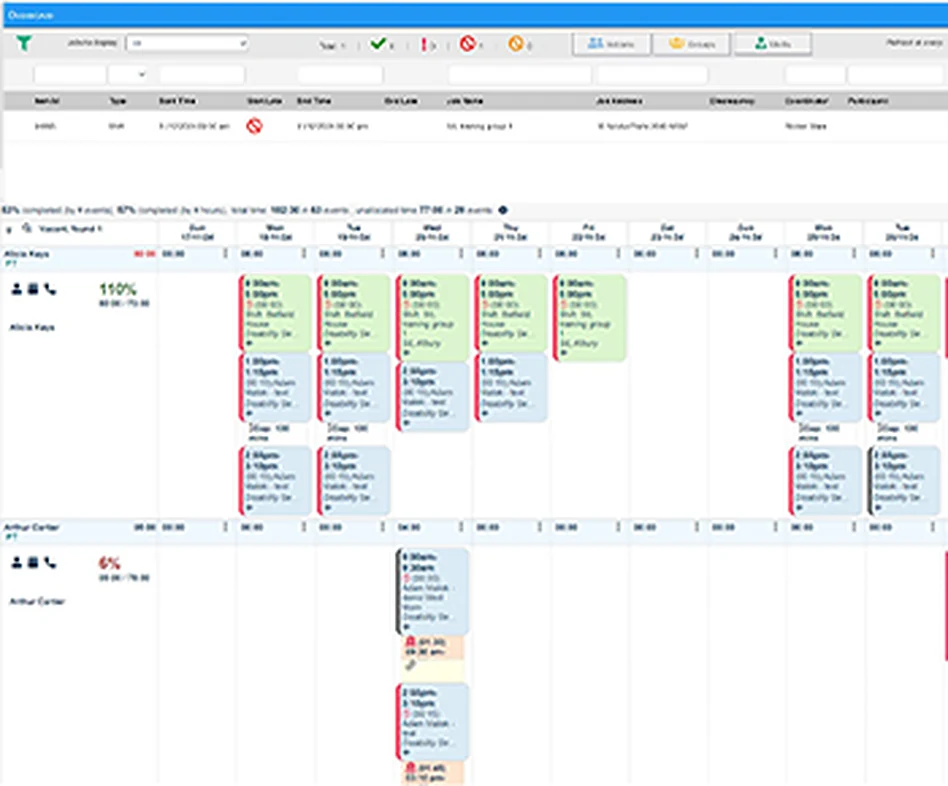
VisiCase works with its clients to provide a platform that enables faster, smarter workforce planning, roster management and scheduling and more open and transparent communication.
We encourage a genuine focus on employer branding and acknowledge the lengths this can go to enabling organisations to attract, retain and recruit quality frontline workers.
—
VisiCase provides an NDIS-ready business automation platform, built on powerful workflows. It helps you manage, streamline, and optimize every component of your business, and its modules empower a positive employee and client experience.
Image by Cristina Seri
Frequently Asked Questions
What are the main challenges of working in the NDIS frontline?
Frontline workers experience unpaid overtime, spend over two hours daily on administrative tasks post-shift, face unpredictable schedules across multiple jobs, earn below national average wages, and lack sufficient supervisor guidance due to industry-wide staffing shortages.
How stable is employment for workers in the NDIS?
While permanent employment has risen to 62%, workforce casualisation remains a major concern. Many frontline employees must manage multiple part-time jobs and unpredictable shift rosters, which creates personal instability and impacts client service continuity.
Why do NDIS workers experience supervisor support gaps?
Mid-level managers and supervisors often oversee too many employees due to broader industry skill shortages. Consequently, nearly half of frontline workers report having insufficient time with supervisors, forcing Cert IV staff to make critical client decisions independently.
Why are frontline staff leaving NDIS sector jobs?
High burnout, unpaid administrative hours, lack of career progression pathways, and off-the-clock training requirements drive attrition. Research indicates many frontline workers plan to leave the industry within five years despite growing participant demand.
How can frontline workers improve their working conditions in the NDIS?
Frontline employees can improve conditions by maintaining proactive, constructive communication with management regarding salary, rosters, training, and career goals. Transparent dialogue helps providers address workplace challenges and build better organizational structures.